for the web-base tool and the code, scroll down!
The Counterintuitive Problem
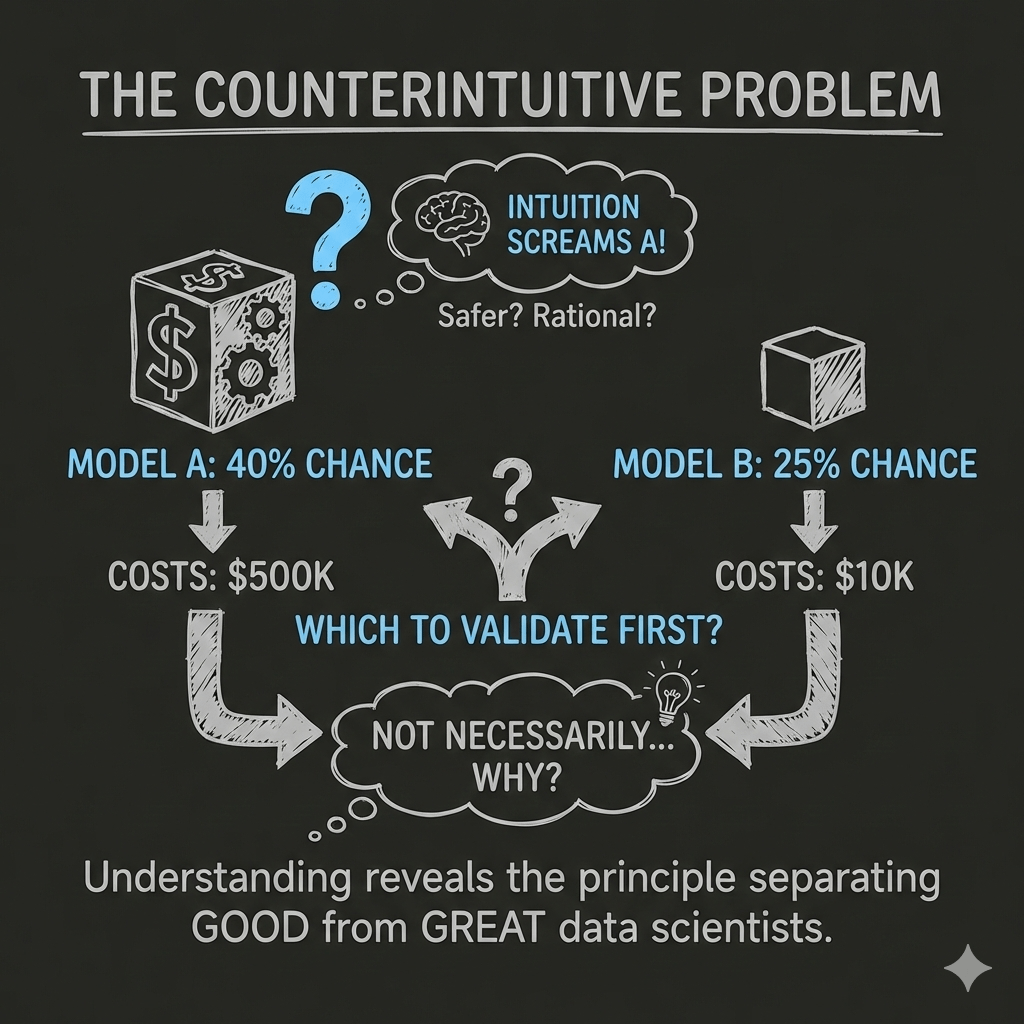
When leading my data science team, I usually find myself in a situation where I need to evaluate two potential ML models for production:
- Model A:
40%chance of meeting performance targets, but requires$500Kin compute and engineering to test and validate - Model B:
25%chance of success, but only$10Kto test and validate
Which would you validate first?
If you’re like most people, your intuition screams “Model A!” It is higher in probability, so it feels safer. It’s the rational choice, right?
Not necessarily.. and understanding why reveals a fundamental principle that separates good data scientists from great ones.
Understanding the Baseline: What Does Success Look Like?
Before we dive into the strategies, let’s establish what “success” means in this scenario.
The Reward: If either model meets your performance targets, it generates $2,000K in value to your company. This reward could be:
- Annual revenue increase from better recommendations
- Cost savings from more efficient operations
- Competitive advantage worth this much to stakeholders
The Question: Looking back at the options above, should you spend $500K to test the 40% probability option, or $10K to test the 25% probability option first?
I emphasised the word first, as the order in which you test these models determines not just your expected profit, but your risk exposure, capital efficiency, and learning trajectory.
Strategy 1: Test A First (The Intuitive Approach)
Let’s see this decision and the consequences would be (I’ll explain every calculation, don’t worry).
STEP 1: You commit $500K to Test Model A
The moment you start testing Model A, you’ve committed $500K. This money is gone regardless of the outcome. Let’s say it pays for:
- GPU compute time for training
- Engineering hours for implementation
- Data pipeline development
- Validation infrastructure
Critical Point: This $500K is a sunk cost the moment you begin. You cannot get it back.

Now we wait for the results. There are three possible scenarios:
SCENARIO 1: Model A Succeeds (40% probability of success)
What would happen:
- Your $500K investment pays off
Model Ameets performance targets- You deploy it and capture the
$2,000Kin value - You stop testing (no need to try
Model B)
Financial Accounting:
Revenue from deploying Model A:    +$2,000K
Money spent testing A:             -$500K
───────────────────────────────────────────
Net Profit:                        +$1,500K
Why $1,500K and not $2,000K?
Because you had to spend $500K to discover that Model A works. That’s the cost of validation. Your gross revenue is $2,000K, but your net profit (revenue minus costs) is $1,500K
Expected contribution: remember this model has a 40% probability of success. This means that this happens 40% of the time, also meaning in a mathematical form:
0.40 × $1,500K = $600K
SCENARIO 2: Model A Fails, Then B Succeeds
Let’s say we test Model A for $500K and it fails to validate, then
- You’re down $500K with nothing to show for it
- But you don’t give up! You still have Model B
- You spend another $10K to test Model B
- Model B succeeds and captures the $2,000K value
Financial Accounting:
Money already spent on A:           -$500K (sunk cost)
Revenue from A:                      $0 (it failed)
Additional cost to test B:          -$10K
Revenue from deploying B:           +$2,000K
─────────────────────────────────────────────
Net Profit:                         +$1,490K
Probability Calculation:
This scenario requires TWO things to happen:
- Model A must fail: 60% chance (100% – 40% = 60%)
- Model B must succeed: 25% chance
Combined probability = 0.60 × 0.25 = 0.15 or 15%
Why multiply? Because both events must occur in sequence.
Note: we assumed that the two solutions are independent (the failure of one solution does not tell you anything about the other); yet this is not always the case. We will talk about this later in the post.
Expected contribution to total Expected Value: 0.15 × $1,490K = $223.5K
SCENARIO 3: Both Models Fail
If Model A fails (after spending $500K) and Model B also fails (after spending $10K more)
- You’ve exhausted all options
- No revenue is generated
Financial Accounting:
Money spent testing A:              -$500K
Revenue from A:                     $0 (failed)
Money spent testing B:              -$10K
Revenue from B:                     $0 (failed)
─────────────────────────────────────────────
Total Loss:                         -$510K
Probability Calculation:
This requires TWO failures:
- Model A fails: 60% chance
- Model B also fails: 75% chance (100% – 25% = 75%)
Combined probability = 0.60 × 0.75 = 0.45 or 45%
Important Insight: This is the most likely outcome! Almost half the time, you’ll lose $510K.
Expected contribution to total Expected Value: 0.45 × (-$510K) = -$229.5K
Calculating Expected Value for Strategy A→B
Expected Value is the probability-weighted average of all possible outcomes.
The Formula:
EV = (Prob of Outcome 1 × Value of Outcome 1)
   + (Prob of Outcome 2 × Value of Outcome 2)
   + (Prob of Outcome 3 × Value of Outcome 3)
Plugging in our numbers:
EV(A→B) = (0.40 × $1,500K) + (0.15 × $1,490K) + (0.45 × -$510K)
        = $600K + $223.5K - $229.5K
        = $594K
What does this mean?
If you run this experiment 1,000 times, you’d average $594K profit per attempt. Some attempts you’d make $1,500K, some you’d lose $510K, but the average would be $594K.
Strategy 2: Test B First (The Information-Driven Approach)
Now let’s analyse testing Model B first. Same reward ($2,000K), same probabilities, but different cost structure.
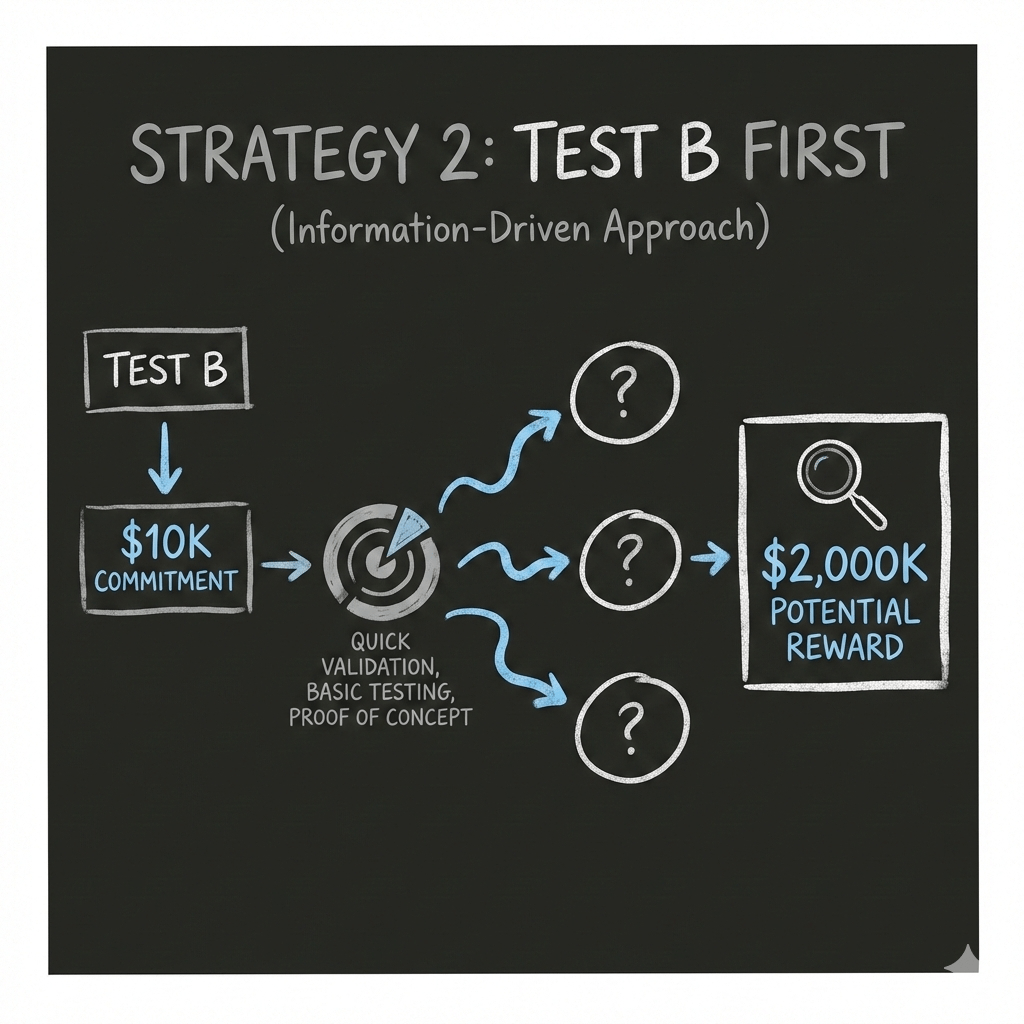
STEP 1: You Commit $10K to Test Model B
Much smaller upfront investment, only $10K for:
- Quick prototype validation
- Basic performance testing
- Initial proof of concept
The Three Possible Outcomes
SCENARIO 1: Model B Succeeds (25% probability of success)
- Your
$10Kinvestment pays off immediately - Model B meets performance targets
- You deploy it and capture the
$2,000Kvalue - You stop testing (no need to try
Model A)
Financial Accounting:
Revenue from deploying Model B:    +$2,000K
Money spent testing B:              -$10K
─────────────────────────────────────────────
Net Profit:                         +$1,990K
Why $1,990K is HUGE: You only spent $10K to unlock $2,000K in value. Compare this to Strategy A→B where early success gave you only $1,500K (because you spent $500K).
When the cheap test succeeds, you keep almost all the reward!
Probability: This happens 25% of the time. That means the expected contribution to total Expected Value= 0.25 × $1,990K = $497.5K
Compare to A→B: Testing A first contributed $600K from early success. Testing B first contributes only $497.5K from early success. So far, A→B seems better, right? Keep reading…
SCENARIO 2: Model B Fails, Then A Succeeds
- You test Model B for
$10K.. it fails - You’re down
$10Kbut that’s manageable - You still have
Model Ato try - You spend
$500Kto testModel A - Model A succeeds and captures the
$2,000Kvalue
Financial Accounting:
Money already spent on B:           -$10K (sunk cost)
Revenue from B:                     $0 (it failed)
Additional cost to test A:          -$500K
Revenue from deploying A:           +$2,000K
─────────────────────────────────────────────
Net Profit:                         +$1,490K
This is the SAME net profit as Strategy A→B’s Scenario 2! When the second test succeeds, you end up with $1,490K regardless of which order you tested.
Probability Calculation:
Model Bmust fail:75%chance (100% - 25% = 75%)Model Amust succeed:40%chance
Combined probability = 0.75 × 0.40 = 0.30 or 30%
HUGE DIFFERENCE: This scenario happens 30% of the time with B→A but only 15% of the time with A→B!
Why? Because B fails more often (75% vs 60%), which means you get more opportunities to try A as your second option.
Expected contribution to total EV: 0.30 × $1,490K = $447K
Compare to A→B: Testing A first, this scenario contributed $223.5K. Testing B first, it contributes $447K. That’s a $223.5K difference!
SCENARIO 3: Both Models Fail
Model Bfails (after spending $10K)Model Aalso fails (after spending $500K more)- You’ve exhausted all options
- No revenue is generated
Financial Accounting:
Money spent testing B:              -$10K
Revenue from B:                     $0 (failed)
Money spent testing A:              -$500K
Revenue from A:                     $0 (failed)
─────────────────────────────────────────────
Total Loss:                         -$510K
Key Point: This is EXACTLY the same as Strategy A→B! Both fail, you lose $510K regardless of order.
Probability Calculation:
- Model B fails: 75% chance
- Model A also fails: 60% chance
Combined probability = 0.75 × 0.60 = 0.45 or 45%
Same probability as A→B: This outcome happens 45% of the time either way.
Expected contribution to total EV: 0.45 × (-$510K) = -$229.5K
Calculating Expected Value for Strategy B→A
EV(B→A) = (0.25 × $1,990K) + (0.30 × $1,490K) + (0.45 × -$510K)
        = $497.5K + $447K - $229.5K
        = $715K
The Comparison: Why B→A Wins by $121K
Let’s put the strategies side by side:
| Strategy | Expected Value | Difference |
|---|---|---|
| Test A First (A→B) | $594K | — |
| Test B First (B→A) | $715K | +$121K |
Testing B first gives you 20% more expected value! – Byt WHY?
Breaking Down Where the Advantage Comes From
Let’s look at each outcome’s contribution:
| Outcome | A→B Contribution | B→A Contribution | Difference |
|---|---|---|---|
| First test succeeds | $600K (40% × $1,500K) | $497.5K (25% × $1,990K) | -$102.5K ❌ |
| Second test succeeds | $223.5K (15% × $1,490K) | $447K (30% × $1,490K) | +$223.5K ✅ |
| Both fail | -$229.5K (45% × -$510K) | -$229.5K (45% × -$510K) | $0 — |
| TOTAL | $594K | $715K | +$121K ✅ |
The Key Insight
Testing A first:
- ✅ Better if first test succeeds (+$102.5K advantage)
- ❌ Worse if first test fails (-$223.5K disadvantage)
- The disadvantage is LARGER than the advantage
Testing B first:
- ✅ You lose $102.5K when the first test succeeds (25% chance)
- ✅ You gain $223.5K when the first test fails (75% chance)
- The gain is more frequent and larger!
Why This Is Counterintuitive: The Psychology of Probability
Most people choose A→B because:
- Probability bias: “40% is better than 25%”.. true, but it ignores costs
- Loss aversion: Afraid to “waste” the first attempt on the lower probability
- Sunk cost fallacy: Once $500K is spent, you’re pot-committed
- Outcome focus: Thinking about “which will work” rather than “how do I learn efficiently”
But the math shows: information efficiency beats probability when costs differ dramatically.
The Core Principle: Information Gain Per Dollar
This isn’t about probability alone.. it’s about information efficiency. We can quantify this:
Information Gain per Dollar = Probability / Cost
Model A: 0.40 / $500K = 0.0008 per $1K
Model B: 0.25 / $10K = 0.0250 per $1K
Model B gives you 31x more information per dollar spent.
If you are interested in the tool/code, please visit this link

When to Test the High-Probability Option First
The “cheap-first” heuristic isn’t a universal law. There are specific, mathematically provable moments where you should ignore the cheap option and go straight for the expensive, high-probability Model A.
Let’s start with an analogy.. Imagine you are a librarian and a fire starts. You have two choices:
- The Cup (Model B): It’s free and right next to you, but it only has a 5% chance of putting out the fire.
- The Fire Hose (Model A): It costs £500 to activate and takes 2 minutes to set up, but it has a 95% chance of saving the building.
If you spend 2 minutes trying to use the cup and fail, the fire is now so big that even the hose won’t work. The “cheap” option didn’t just fail; it stole the time you needed for the only solution that actually mattered.
In AI roadmaps, this happens in two main scenarios:
1. The “Black Friday” Effect (Time Pressure)
When a deadline is so tight that delay costs more than the savings of a cheap test, speed trumps efficiency.
If your company earns $300,000 in extra revenue per day from a working model, every day spent on a “cheap” experiment that fails is a day of lost revenue. If testing the cheap model takes 10 days and leaves you with zero time to try the expensive one before a major event (like Black Friday), the “cheap” test is actually a catastrophic risk.
2. Massive Probability Gaps
There is a point where one option is so overwhelmingly likely to succeed that the “information gain” of the cheap option becomes negligible.
While it is surprisingly difficult for probability to beat cost – even a 49x probability advantage (98% vs 2%) often still favors the cheap option- there is a mathematical break-even point. If you are choosing between a near-certain, proven technology and a “one-in-a-million” long shot, don’t pay the “lottery ticket tax.”
So don’t be dogmatic. The goal isn’t always to “fail fast” .. it’s to succeed before the window closes.
What if the models/solutions are dependent?
In the previous sections, we assumed that the two solutions are independent (the failure of one solution does not tell you anything about the other); yet this is not always the case in real life. But the good thing that I already implemented in the tool – so if you didn’t check it yet please do ( please visit this link)

 Habboub's Lab